

Digital transformation initiatives fail at alarming rates, often due to unclear workflows and communication breakdowns. Many IT decision-makers struggle to align stakeholders, manage scope changes, and measure success effectively. This guide provides a structured approach to technology consulting that reduces timelines, improves governance, and delivers measurable results for medium to large enterprises seeking operational efficiency.
Table of Contents
- Prerequisites: What You Need Before Starting
- Core Steps of the Technology Consulting Workflow
- Common Mistakes and How to Avoid Them
- Alternative Approaches: Tradeoffs and Decision Criteria
- Expected Results and Outcomes
- Explore Solyn Global's Technology Consulting Solutions
- Frequently Asked Questions
Key Takeaways
| Point | Details |
|---|---|
| Structured workflows reduce project timelines by 30% | Clear processes eliminate redundant steps and improve coordination across teams |
| Prerequisites ensure project readiness | Documented objectives and stakeholder alignment prevent costly delays |
| Strong governance cuts project delays by 25% | Defined roles and escalation paths maintain momentum |
| Defined metrics increase success rates by 50% | Measurable KPIs enable objective evaluation and continuous improvement |
| Methodology selection depends on enterprise context | Risk tolerance, size, and compliance needs determine optimal approach |
Prerequisites: What You Need Before Starting
Successful technology consulting requires thorough preparation. Rushing into engagements without proper groundwork leads to scope creep, budget overruns, and stakeholder frustration.
Start with documented business objectives. Your digital transformation goals must be specific, measurable, and tied to concrete outcomes like revenue growth or cost reduction. Vague aspirations create misalignment later.
Next, audit your current IT infrastructure and processes. You need baseline documentation showing what systems exist, how they integrate, and where gaps or inefficiencies appear. This assessment reveals constraints and opportunities.
Stakeholder identification matters more than most realize. Map everyone affected by the project, from executive sponsors to end users. Create engagement plans detailing how you'll communicate with each group, addressing their concerns and securing buy-in.
Confirm resource availability and budget before signing contracts. You need dedicated team members, not people splitting time across five initiatives. Budget must cover the full project scope plus a 15% contingency for unexpected challenges.
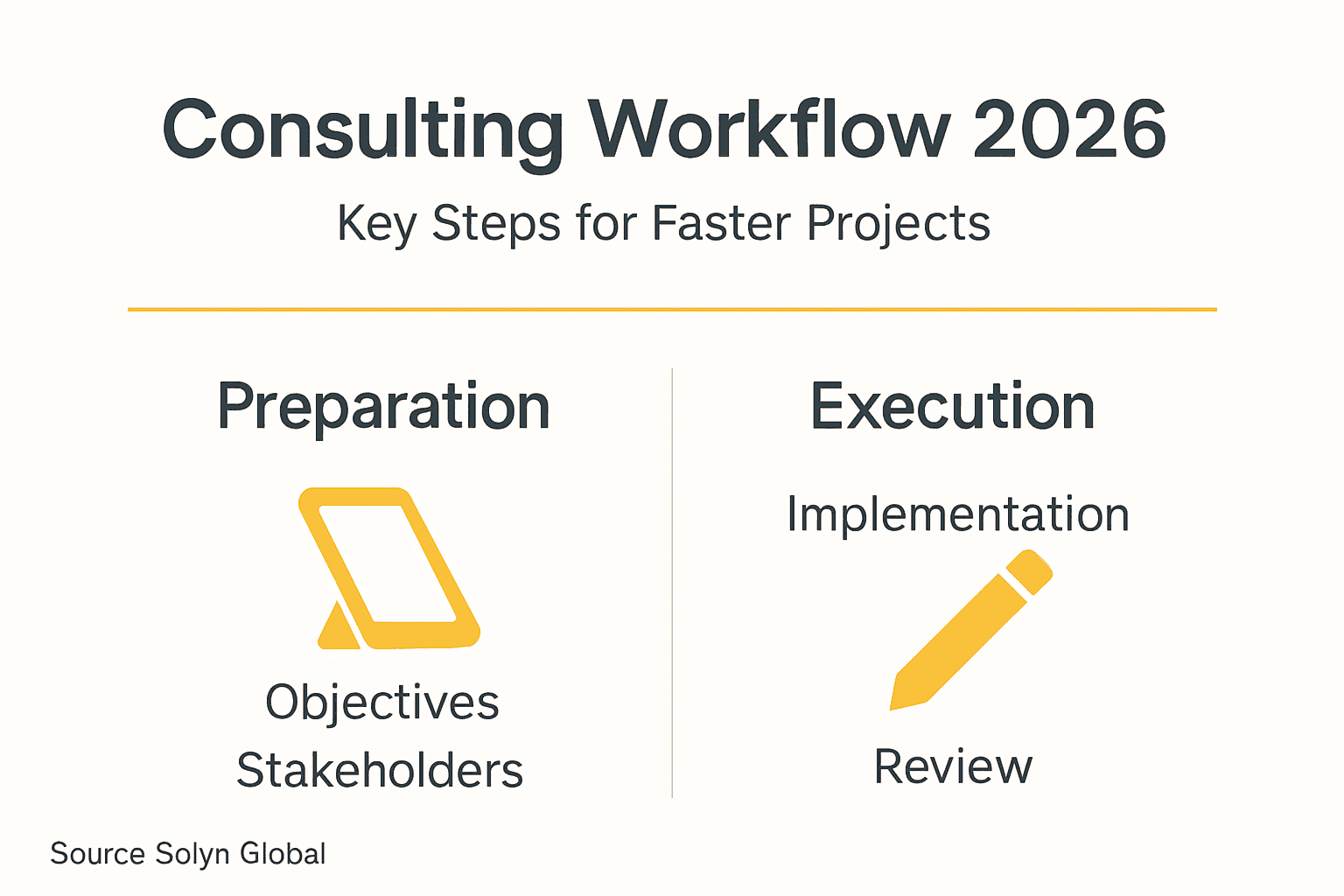
Pro Tip: Hold alignment workshops with all stakeholders before starting. These sessions surface hidden assumptions and conflicting priorities early, when they're easiest to resolve.
Key preparation checklist:
- Business objectives documented with success metrics
- Current state IT assessment completed
- Stakeholder map with engagement strategy
- Dedicated resources confirmed and scheduled
- Budget approved with contingency included
- Executive sponsorship secured with clear accountability
Core Steps of the Technology Consulting Workflow
A structured workflow transforms consulting from chaotic firefighting into predictable execution. Each step builds on the previous one, creating momentum while maintaining control.
- Conduct Comprehensive Needs Assessment
Start by analyzing your organization's current state against desired outcomes. Identify gaps in capabilities, processes, and technology. Prioritize based on business impact and implementation complexity. This foundation guides everything that follows.
- Review Current IT Landscape
Document existing systems, integrations, and workflows in detail. Understand constraints like legacy technology debt, compliance requirements, and skill gaps. This reality check prevents unrealistic expectations and uncovers hidden dependencies.
- Develop and Validate Strategy
Create a roadmap aligning technical solutions with business goals. Present options with clear tradeoffs regarding cost, timeline, and risk. Validate with stakeholders to ensure buy-in before moving forward. Strategy misalignment here causes most project failures.
- Design Detailed Solutions
Translate strategy into specific architectures, workflows, and implementation plans. Define technical specifications, integration points, and data migration approaches. Include security, scalability, and maintenance considerations from the start.
- Execute with Strong Governance
Implement solutions using your chosen methodology while maintaining rigorous oversight. Establishing a governance framework with defined roles and escalation paths reduces project delays by 25% in consulting workflows. Regular status updates keep stakeholders aligned and surface issues early.
"Governance is not bureaucracy when done right. It's the communication structure that prevents small problems from becoming project killers."
- Perform Post-Implementation Review
Evaluate results against original objectives. Measure efficiency gains, cost savings, and user satisfaction. Document lessons learned to improve future initiatives. This step often gets skipped, but it's where you lock in continuous improvement.

Common Mistakes and How to Avoid Them
Even well-intentioned consulting projects stumble over predictable obstacles. Understanding these patterns helps you avoid them.
Poor stakeholder communication causes 45% of consulting failures. IT teams focus on technical excellence while business users feel ignored. Fix this with weekly stakeholder updates, not just status reports but two-way conversations. Create feedback loops where users shape decisions.
Inadequate risk assessment appears in 40% of failed projects. Teams identify obvious risks but miss subtle dependencies and assumptions. Conduct formal risk reviews during planning, not just execution. Challenge every assumption and document mitigation strategies.
Lack of clear success metrics leads to 35% of failures. Projects drift because no one defined what "done" looks like. Set measurable KPIs at project start, tied to business outcomes not just technical deliverables. Track them throughout.
Overlooking security risks results in 30% budget and timeline overruns. Security gets treated as an afterthought, then requires expensive rework. Mandate security evaluations during design phase. Include security professionals in architecture reviews.
Pro Tip: Establish your governance framework before project kickoff, not during execution. This prevents many common risks by creating clear decision-making authority and escalation paths from day one.
Key avoidance strategies:
- Schedule recurring stakeholder sessions with structured agendas
- Run formal risk workshops quarterly with cross-functional teams
- Define and baseline KPIs in project charter
- Integrate security reviews into every design milestone
- Document assumptions explicitly and validate them regularly
Alternative Approaches: Tradeoffs and Decision Criteria
Choosing between Waterfall and Agile consulting workflows significantly impacts project execution and outcomes. Neither approach is universally superior; context determines fit.
Waterfall provides sequential milestones with comprehensive documentation at each phase. This structure suits large, compliance-heavy projects where requirements are stable and regulatory oversight demands detailed audit trails. Control is high, but flexibility is limited.
Agile offers iterative delivery with frequent feedback cycles. This fits medium enterprises with collaborative cultures needing faster results. You adapt to changing requirements easily, but scope control requires discipline and strong product ownership.
| Factor | Waterfall | Agile |
|---|---|---|
| Feedback Cycles | End of phase | Every sprint |
| Scope Control | Formal change process | Continuous prioritization |
| Documentation | Comprehensive upfront | Just-in-time |
| Risk Exposure | Late discovery | Early and continuous |
| Compliance Fit | Excellent | Requires adaptation |
| Team Structure | Specialized roles | Cross-functional |
Your risk tolerance matters most. Highly regulated industries often need Waterfall's documentation and control. Fast-moving sectors benefit from Agile's adaptability.
Enterprise size influences success too. Larger organizations struggle with Agile's communication overhead across departments. Smaller teams coordinate more easily.
Decision criteria for methodology selection:
- Regulatory requirements and audit needs
- Requirement stability and change frequency
- Team size and geographic distribution
- Stakeholder involvement capacity
- Existing organizational culture and processes
- Timeline constraints and delivery expectations
Expected Results and Outcomes
Realistic expectations prevent disappointment and enable objective success evaluation. Technology consulting projects deliver measurable value when properly executed.
Typical projects run six to twelve months depending on scope and complexity. Larger transformations involving multiple systems take longer, while focused improvements complete faster. Structured workflows yield 30% faster completion compared to ad hoc approaches.
Clear success metrics improve project success rates by 50%. When everyone understands what success looks like, teams align efforts and make better tradeoff decisions. Ambiguity kills momentum.
Post-implementation reviews consistently reveal 15 to 20% operational efficiency gains in well-executed projects. These come from eliminated manual processes, improved data access, and better decision support.
| Metric | Baseline | With Structured Workflow | Improvement |
|---|---|---|---|
| Project Duration | 10 months | 7 months | 30% faster |
| Success Rate | 60% | 90% | 50% increase |
| Efficiency Gain | N/A | 15-20% | Measurable |
| Budget Variance | +25% | +5% | 80% reduction |
| Stakeholder Satisfaction | 65% | 85% | 31% increase |
You should see early wins within the first quarter, even for longer projects. Quick victories build stakeholder confidence and maintain executive support through challenging phases.
Pro Tip: Monitor KPIs continuously, not just at project end. Weekly metric reviews let you course-correct before small issues become major problems. This ongoing attention sustains digital transformation benefits long after implementation.
Explore Solyn Global's Technology Consulting Solutions
Navigating complex digital transformations demands expertise and proven methodologies. Solyn Global specializes in tailored technology consulting for medium to large enterprises seeking measurable results.
Our structured workflows incorporate governance frameworks and success metrics that reduce project timelines by 30% while improving outcomes. We guide organizations from initial needs assessment through implementation and post-project optimization, ensuring every initiative delivers operational efficiency gains.
With experience across healthcare, automotive, and enterprise sectors, our consultants understand the unique challenges IT decision-makers face. We bring 24/7 support and a track record of successful implementations across a dozen countries.
Ready to accelerate your digital transformation with reduced risk and clear KPIs? Visit our technology consulting services by Solyn Global to discover how our expert team can support your objectives and deliver results that matter.
Frequently Asked Questions
What are the first steps to prepare for technology consulting?
Start by documenting your business objectives with specific, measurable outcomes. Complete a current state IT assessment showing existing systems, integrations, and gaps. Create a stakeholder map identifying everyone affected by the project and develop engagement plans for each group.
How can I measure success during and after consulting projects?
Define measurable KPIs in your project charter tied to business outcomes like cost reduction or revenue growth, not just technical deliverables. Track these metrics weekly during execution and compare post-implementation results against baseline measurements. Include stakeholder satisfaction scores and operational efficiency metrics in your evaluation.
Which workflow is best for highly regulated industries?
Waterfall typically fits highly regulated industries better due to comprehensive documentation requirements and formal change control processes. The sequential milestone structure provides clear audit trails and supports compliance needs. However, you can adapt Agile with additional documentation and governance layers if faster feedback cycles provide sufficient value.
How do I manage scope creep in Agile workflows?
Establish a strong product owner with decision-making authority and maintain a ruthlessly prioritized backlog. Implement formal change approval processes even in Agile, requiring business case justification for new requests. Use time-boxed sprints to force tradeoff discussions, ensuring new work displaces lower priority items rather than expanding scope.
What is the typical cost range for technology consulting engagements?
Costs vary widely based on scope, complexity, and duration. Small focused improvements start around $50,000, while comprehensive digital transformations for large enterprises range from $500,000 to several million dollars. Expect to invest 10 to 15% of total project cost in consulting fees, with remaining budget covering technology, implementation, and change management.